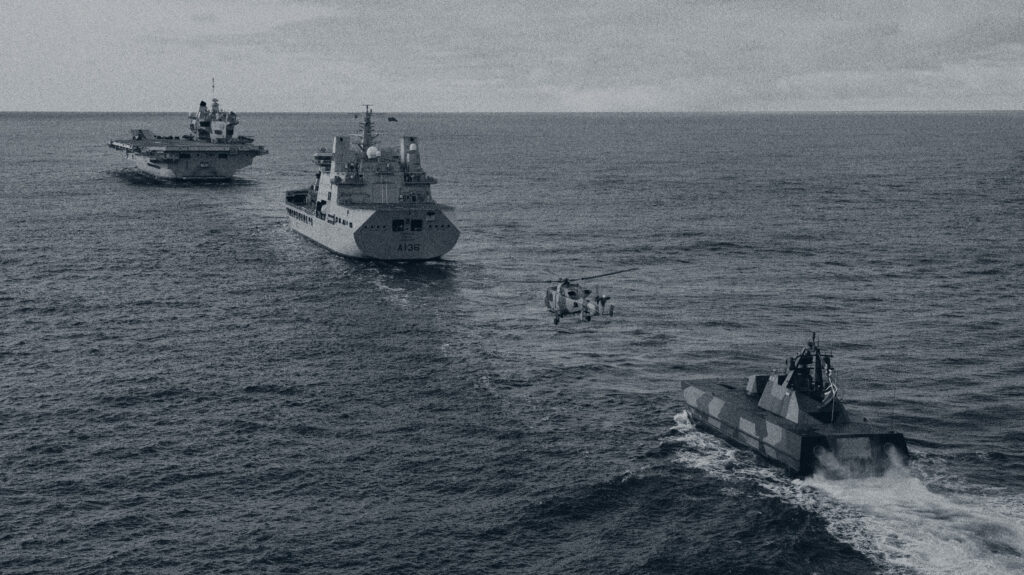
Our proprietary technology stack unlocks true autonomy in complex and contested maritime environments. Vehicle and sensor-agnostic, it combines data fusion and edge computing to deliver real-time perception, understanding, and response for unmatched awareness.
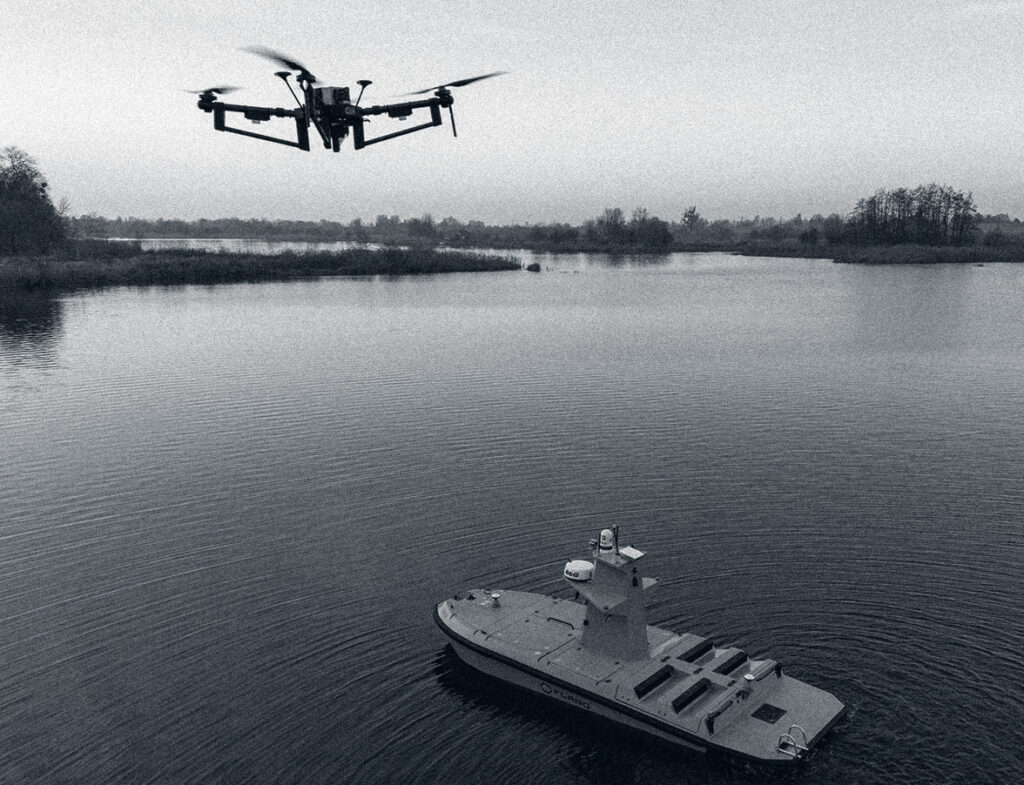
FLANQ USVs are smart USVs – intelligent, scalable, and highly customisable. Designed for the mission – whatever the mission – they can carry diverse senor and effector payloads and excel in both solo and coordinated, wolf pack deployments.
FLANQ-powered autonomous and remotely controlled underwater vehicles play a critical role in modern defence, enhancing capabilities across surveillance, reconnaissance, and combat missions – from naval base protection to underwater warfare training.
Transform your situational awareness above and below the water. Optimised for size, weight and power and integrated using FLANQ’s Q-KONTROL backbone, our vehicle-agnostic technologies let you sense threats, decide the outcome and enable the response.
In 2025, FLANQ and CiS announced a partnership agreement to jointly develop and deploy Unmanned Aerial Vehicles (UAVs) from Uncrewed Surface Vessels (USVs). In the first of two long read blog posts, we take a deep dive into the partnership. In part one, we explore the new realities of defence in Europe and in part two, the technical challenges of launching and recovering a quadcopter on a moving target which can – depending on the variant – be not much bigger than a standup paddle board. (8-minute read)
Persistent. Distributed. Scalable Across Europe’s eastern and northern flanks, the security environment is shifting in ways that demand new approaches to surveillance and response. From the Baltic Sea to the High North, European governments are confronting a complex mix of challenges – increased geopolitical tension, heightened concern over the protection of critical undersea infrastructure, and the persistent activity of “shadow fleets” penetrating territorial waters.
These developments are occurring across an enormous maritime area. Thousands of kilometres of subsea communication cables, pipelines and offshore energy infrastructure now underpin Europe’s economy and energy security. Yet monitoring this environment remains a demanding task, particularly when relying on traditional (crewed) military doctrine designed for a different era.
The result is a growing recognition across EU defence and security communities that maritime awareness must become more persistent, more distributed and more scalable. Increasingly, that conversation is turning towards collaborative autonomous systems.
The limits of traditional maritime surveillance Europe’s naval and coastguard forces operate some of the most capable surveillance assets in the world. Maritime patrol aircraft and specialist surveillance vessels provide exceptional sensing capability and operational reach. But these assets are also finite.
Exquisite platforms – whether aircraft or ships – are expensive build, operate and limited in number. Their deployment must be carefully prioritised, and even the most capable systems cannot remain on station indefinitely. As a result, large areas of sea space often rely on periodic patrols rather than continuous monitoring.
This approach is increasingly mismatched with today’s threat environment. Activities such as sanction evasions, suspicious vessel rendezvous, or potential interference with subsea infrastructure may occur in narrow time windows. Detecting and understanding these events often requires persistent presence rather than irregular patrols.Maintaining that level of coverage using traditional platforms alone is neither practical nor economically sustainable.
Look only to events in the Middle East when, in early March 2026, a UK RAF base on the Mediterranean island of Cyprus was attached with an aerial drone. The UK government quickly responded by committing to send a Royal Navy Type 45 destroyer to region to provide an air defence capability for the island – a destroyer that was hundreds of miles away in the UK undergoing planned maintenance. It took around two weeks to prepare the vessel and set sail. High tempo regional conflicts like these expose critical short comings in a nation’s operational readiness and ability to protect its own sovereignty and those of its close allies.
Uncrewed first Across NATO and European defence planning, uncrewed systems are now considered mature enough to form the persistent foundation of maritime awareness. Rather than replacing traditional assets, these systems provide a distributed sensing layer that operates continuously across large areas of ocean. Crewed platforms can then be deployed selectively when higher levels of investigation, visual deterrent or strike capability are required.
This new vision for “uncrewed wherever possible, crewed only where necessary” doctrine reflects both operational logic and economic reality. Autonomous surface vessels – procured, built and deployed in weeks not years – can remain at sea for extended periods, conducting intelligence gathering tasks at a fraction of the operating cost associated with crewed platforms. Just as importantly, they reduce risk to personnel while expanding the geographic reach of maritime monitoring.
However, the real step change is not autonomy alone. It lies in how autonomous systems increasingly work together – and not just swarms of the same type – but subsea, surface and aerial platforms intelligently cooperating much in the same way a traditional carrier strike group is configured.
From single platforms to collaborative autonomy Early deployments of naval maritime autonomy often focused on individual platforms – a drone deployed off the back deck, an uncrewed vessel launched from a mother ship, or a remote sensor network deployed in the seafloor. While valuable, these standalone systems inevitably face limitations in coverage and flexibility.
FLANQ USVs can loiter on station for weeks, but if something is detected at long range and closer inspection is required, there is a time and tactical trade-off. Time to sail to the contact (which may have left the detection area) and tactical in terms of revealing your position and becoming a target itself. An aerial drone like those from CiS can survey large areas quickly but cannot remain airborne indefinitely. Collaborative autonomy – as demonstrated at last year’s REPMUS exercise in Portugal – addresses this challenge by combining the strengths of different platforms.
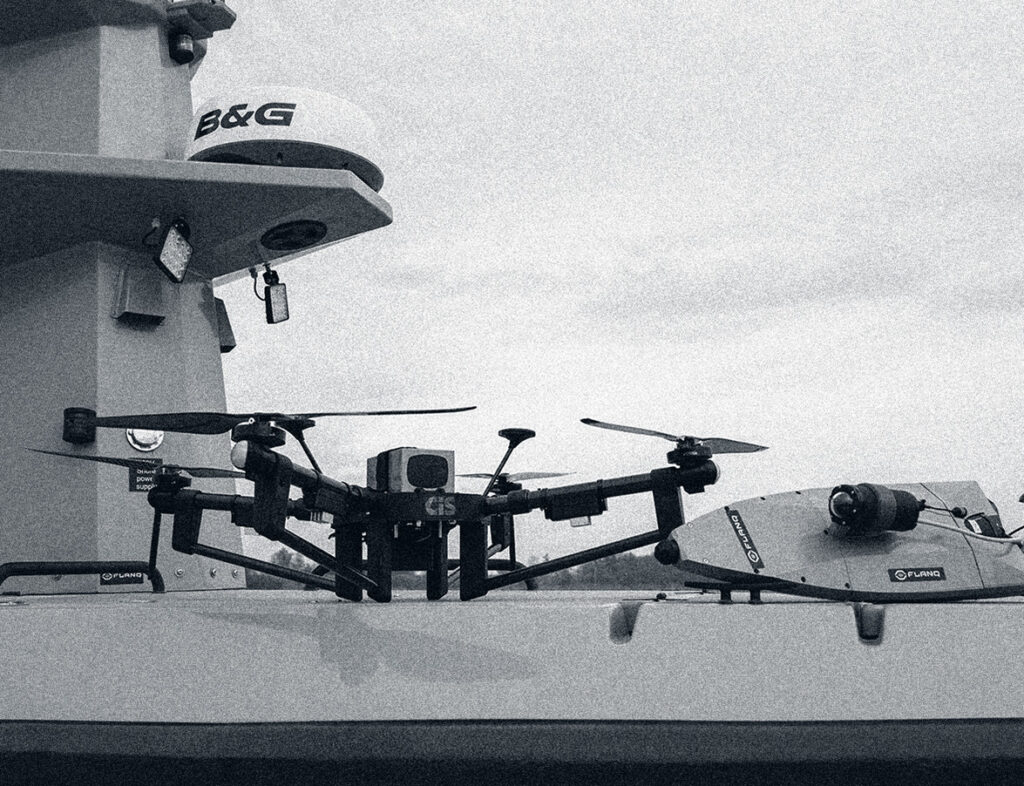
A FLANQ uncrewed surface vessel provides endurance, surface and subsea perception, communications connectivity and now – hangar space for an UAV. CiS’ flagship quadcopter, Orka, can be remotely tasked airborne in around 10 seconds, travel at 100 kph to investigate contacts, and even designate targets. Together, the two platforms operate as a single coordinated system-of-systems, sharing data and tasks to build a richer picture of the maritime environment.
Modern autonomous systems increasingly rely on integrated sensor suites and data fusion to combine multiple sources of information, including electro-optical cameras, radar and other maritime sensors, into a unified operational picture that can support operator decision-making in real-time. The result is a surveillance capability that is both persistent and responsive.
Monitoring the Baltic and High North The value of this approach becomes particularly clear in the context of European waters. The Baltic Sea, for example, is one of the world’s busiest and most strategically sensitive maritime regions. Commercial shipping, energy infrastructure and naval activity all coexist within a relatively confined operating space. Monitoring vessel behaviour in such an environment requires sustained observation and the ability to investigate anomalies quickly.
Shadow fleet activity presents a different but equally demanding challenge. Vessels operating with their AIS transponder disabled, spoofing GNSS, dragging the anchors, or following unusual routes can be difficult to track using conventional patrol patterns. Persistent autonomous monitoring using USV-UAV assets to shadow the shadow fleets can help identify these patterns earlier and maintain visibility over vessels of interest for extended periods.
Europe’s northern flank presents a different operational problem: scale. Vast areas of ocean, often in harsh environmental conditions, must be monitored despite limited infrastructure and long distances from allied naval bases. Collaborative autonomous systems offer a way to extend surveillance reach without proportionally increasing operational cost.
Persistence without exquisite cost One of the most compelling advantages of distributed autonomous systems is economic. Exquisite platforms – destroyers, aircraft carriers and frigates – remain indispensable for truly frontline operations, as Cyprus illustrates. But when it comes to routine border patrols and wide-area surveillance and early detection tasks, their operating costs can quickly become prohibitive. Decades of defence cuts means that there’s simple too many missions with too few ships. Autonomous systems offer a complementary model.
Lower-cost attributable platforms operating cooperatively can remain on station for weeks, continuously gathering information and building a detailed understanding of maritime activity. When something unusual occurs, higher-capability assets can then be directed with far greater precision.
This layered approach enables security forces to achieve greater coverage and persistence without dramatically increasing budgets, service personnel or physical fleet sizes. In effect, autonomous systems allow navies to scale, and scale quickly.
A collaborative approach to maritime autonomy The partnership between FLANQ and CiS reflects this broader shift in thinking about maritime capability. By integrating autonomous surface vessels with aerial systems and advanced autonomy software, the collaboration aims to deliver a capability that is designed from the outset for diverse maritime security missions – from ISR to MCM to search and rescue. Rather than treating individual platforms as standalone solutions, the focus is on how systems can operate together to extend sensing reach, maintain continuous presence and deliver actionable intelligence, in real-time, straight to commanders.
Such capabilities are increasingly relevant as European nations look to strengthen the protection of their maritime infrastructure and improve visibility across contested sea spaces. Yet delivering this type of collaborative autonomy involves solving a number of complex engineering challenges – none more so than enabling aerial systems to operate reliably from uncrewed surface vessels moving in open water.
In part two of our blog, we explore the technical problem at the heart of this capability: how to launch, recover and recharge UAVs from autonomous surface vessels in real sea conditions.
Rostock, Germany – February 24, 2026 FLANQ, a German manufacturer of autonomous maritime platforms, and DTC Communications, a leading supplier of secure communications systems, today announced a strategic cooperation to market advanced marine tactical radios for maritime security and defence applications across Europe.
The cooperation will focus on pairing DTC’s low-SWaP (Size, Weight and Power) communications technology communications technology into FLANQ’s family of uncrewed surface vessels (USVs) to enable resilient, encrypted command-and-control (C2) links for a wide range of naval missions.
By combining FLANQ’s autonomous maritime platforms with DTC’s proven tactical communications solutions, the partnership aims to deliver next-generation mission capabilities for Intelligence, Surveillance and Reconnaissance (ISR), Critical National Infrastructure (CNI) protection, patrol and interdiction, and joint force interoperability.
The integrated solution will enable operators to securely task, control and monitor FLANQ’s USVs in real-time across contested maritime environments, ensuring reliable connectivity even in Electromagnetic (EM) contested or denied environments.
Key capabilities and outcomes: • Secure, encrypted C2 links for surface and littoral operations • High-bandwidth, low-latency communications for sensor and video feeds • Interoperability with NATO and partner nation command systems • Extended operational range for fully autonomous and remotely controlled missions • Resilience against jamming and interception in hostile environments
Jannik Sauer, Chief Technical Officer at FLANQ (pictured left), said: “Reliable command and control is fundamental to any uncrewed platform in the modern battlespace – whether that’s in the air, land or sea surface. With DTC Communications, we are integrating a robust, secure communications backbone into our USV fleet, ensuring that our users can maintain control, share intelligence, and execute missions with confidence.”
Chris Fulthorpe, Strategic Account Manager at DTC Communications, added: “Our tactical communications solutions have been field-proven in some of the most challenging operational environments. Partnering with FLANQ allows us to extend those capabilities to the maritime domain, ensuring that unmanned surface platforms remain securely connected and mission-effective in any scenario.”
About FLANQ Headquartered in Germany, FLANQ delivers integrated maritime defence solutions, with a focus on autonomous surface platforms, sensor fusion, and rapidly deployed critical infrastructure security systems.
About DTC Communications DTC, a Codan Company, is a global leader in mission-critical communications, delivering secure, resilient voice and data solutions in over 150 countries. Our advanced BluSDR radios, high-performance MANET systems, and MeshUltra™ high-bandwidth mesh networking technologies provide assured connectivity, real-time situational awareness, and tactical advantage in the world’s most demanding and contested environments.
Engineered for the tactical edge, DTC solutions enable rapid deployment, seamless interoperability, and secure data exchange across land, air, and sea domains. Designed to perform in electronically contested and infrastructure-denied environments, our technologies ensure continuous, mission-critical communications when operational success depends on absolute reliability.
Media Contacts: FLANQ external-d.brown@flanqdefence.com David Brown +44 7774 178736
Rostock, Germany – Sept 03, 2025 – FLANQ, a German maritime defence solutions provider, and CiS, a leading developer of autonomous aerial systems, today announced a strategic partnership to jointly develop and deploy an integrated capability enabling the launch and recovery of Unmanned Aerial Vehicles (UAVs) from Uncrewed Surface Vessels (USVs).
The announcement follows successful trials of a CiS Orka tactical air surveillance and reconnaissance drone being hosted, deployed and recovered aboard a 12-foot FLANQ USV operating autonomously in open water at an undisclosed test site.
By merging FLANQ’s proven USV platforms and mission payloads with CiS’s expertise in long-endurance UAV systems, the partnership will deliver a modular, scalable system-of-systems designed to provide rapid-response surveillance, reconnaissance, and intelligence-gathering capabilities, critical to strengthening Europe’s autonomous defence capabilities.
Key objectives of the partnership Include:
• Development of a fully integrated UAV launch-and-recovery systems from medium to large USV platforms • Persistent over-the-horizon ISR (Intelligence, Surveillance, Reconnaissance) enabled by AI-based mission autonomy • Seamless interoperability with NATO maritime command-and-control frameworks • Deployment-readiness for dynamic threat environments, including hybrid and grey-zone conflict scenarios
“This partnership with CiS reinforces our commitment to delivering maritime domain advantage to Europe and its allies,” said Daniel Esser, Co-founder and Chief Commercial Officer of FLANQ. “Together, we are enabling a new level of operational flexibility and responsiveness through intelligent, aerial and uncrewed surface systems.”
Tom Kaufmann, Managing Partner and CEO at CiS, added: “Europe’s maritime borders face increasing threats – from illicit trafficking to shadow fleet sabotage. Through our collaboration with FLANQ, we will deliver an agile, intelligent system that enhances situational awareness and supports decision-makers across the maritime security domain.”
The joint system’s capabilities will be showcased this month at REMPUS 2025 in Portugal, the annual NATO-led military exercise where both companies are participating.
About CiS Established in 1990, CiS is a next-generation UAV developer specialising in long-range, autonomous aerial systems designed for defence, ISR (intelligence, surveillance, and reconnaissance), commercial and civilian applications.
Bellerup, Denmark – August 20, 2025 – Gabler, a leading provider of submarine systems, and FLANQ, a European innovator in autonomous maritime platforms, today announced a strategic partnership to co-develop and deliver a new class of uncrewed surface vessels (USVs) specifically designed for submarine torpedo tube launch (TTL). The announcement was made on the opening day of DALO Industry Days 2025, the largest defence industry exhibition in Scandinavia
This collaboration aims to deliver affordable sub-surface deployed USVs for Intelligence, Surveillance, and Reconnaissance (ISR) operations, as well as single-use tactical missions – significantly enhancing the operational flexibility of European and NATO maritime forces.
The USVs will be fully compatible with standard submarine torpedo tubes, enabling covert deployment without diver assistance. This capability provides a critical advantage for operations in denied, contested, or high-threat environments, where traditional surface or aerial naval assets may be compromised.
Both single-use and reusable USV models will be developed and produced by the two companies, incorporating sovereign suppliers and industrial partners throughout Europe. The expendable variants are designed for one-way missions, such as precision strike, while the reusable platforms will support extended ISR missions with recovery options via host platforms or surface assets.
Under the agreement, Gabler will lead system integration, commercialisation, and delivery to navies globally – building on its market leading portfolio of hoistable mast systems, submarine control technologies, and communication buoys. FLANQ will oversee design, manufacturing and payload integration – drawing on its expertise in modularity, autonomy, and scalable platform engineering.
This joint initiative directly addresses the increasing demand among European and NATO naval forces for autonomous systems capable of operating in complex and contested maritime environments. By enabling submarines to deploy low-cost, mass-produceable USVs for a wide range of missions – from littoral surveillance to deep-sea reconnaissance – this solution delivers domain advantage without compromising stealth.
“Today’s announcement on the opening day of DALO 2025 reflects our shared commitment to strengthening European and allied undersea defence capabilities at pace and cost,” said Lennart Glas, Business Development Manager at Gabler. “By combining FLANQ’s strengths in autonomy, sensor payloads, and rapid manufacturing with Gabler’s six decades of expertise in high-reliability submarine systems, we are fully focussed on delivering mission-specific USVs ready for in theatre testing and evaluation at the earliest opportunity.”
“The development of these platforms comes at a pivotal time for European and allied naval forces,” said Daniel Esser, Chief Commercial Officer and Co-Founder at FLANQ. “Our rapidly produced USVs with their Commercial-Off-The-Shelf (COTS) payloads from sovereign partners – paired with Gabler’s know-how in submarine engineering and operations – will help deliver persistent ISR and tactical reach at scale, speed and value.”
Rostock, Germany and Larnaca, Cyprus – August 05, 2025 – FLANQ, a German-based maritime defence solutions provider, and the Cyprus Marine and Maritime Institute (CMMI), a leading research and innovation centre for the blue economy, today announced the signing of a Memorandum of Understanding (MoU) to collaborate on the development and deployment of uncrewed surface vessels (USVs) for maritime security and defence missions across the Mediterranean.
The cooperation will focus on enhancing operational readiness in contested waters through advanced autonomous technologies. The partners will explore joint solutions that leverage FLANQ’s autonomous surface platforms and CMMI’s maritime research expertise to deliver next-generation mission capabilities in Intelligence, Surveillance and Reconnaissance (ISR), Critical National Infrastructure (CNI) protection, environmental monitoring, and precision strike.
At the heart of this MoU is a shared commitment to accelerating the transition of autonomous surface vessel concepts into operational reality, tailored to the unique challenges of the Mediterranean theatre. Through joint research, trials, and system integration, FLANQ and CMMI will drive innovations that ensure persistent, scalable, and mission-adaptable maritime security solutions.
Daniel Esser, Co-Founder and Chief Commercial Officer at FLANQ, said: “The Mediterranean remains one of the most dynamic and strategically vital regions in the world. By joining forces with CMMI, we can deliver autonomous maritime capabilities that combine scientific excellence with operational agility—strengthening security, resilience, and situational awareness for Cyprus and her regional partners.”
Zacharias Siokouros, CMMI’s Chief Executive Officer added: “This MoU represents a significant milestone for CMMI and for Cyprus. Partnering with FLANQ allows us to bridge cutting-edge maritime science with real-world defence applications, supporting both regional stability and sustainable ocean stewardship.”
Rostock, Germany – June 04, 2025 – FLANQ, a German-based maritime defence solutions provider, and MetOcean Telematics, a global leader in end-to-end telemetry solutions and maritime security technologies, today announced a strategic cooperation focused on advancing persistent submarine surveillance in Germany’s maritime theatre.
This cooperation marks a significant step toward strengthening NATO-aligned undersea situational awareness through intelligent, distributed sensing and data fusion. Together, FLANQ and MetOcean will supply and support commercial-off-the-shelf (COTS) surveillance systems designed to detect, classify, and track submerged threats across contested and congested German waters.
At the core of this initiative is NiKA, MetOcean’s new ASW surveillance instrument, engineered for long-endurance acoustic sensing. Deployed from USV or ship, NiKA autonomously dives to programmed depths to perform real-time passive acoustic surveillance, detecting and classifying adversary signatures across the water column. Depending on mission parameters or when anomalies are detected, NiKA surfaces to transmit data to commanders via Iridium satellite before resubmerging to continue its surveillance cycle.
FLANQ will supply and support the integration of these systems into standalone and integrated maritime security systems-of-systems. Leveraging FLANQ’s autonomous surface platforms and Q-MIND technology stack, the combined system will deliver persistent, wide-area submarine detection and classification capabilities.
Key Capabilities to Be Delivered: • Persistent, scalable underwater detection grid powered by MetOcean’s advanced hydroacoustic NiKA device • Embedded edge processing for real-time sensor monitoring and anomaly detection • Interoperability with NATO and German Navy maritime C2 structures • Rapid deployment, training, and in-theatre containerised sustainment optimised for Baltic and North Sea conditions
“The undersea domain remains one of the most strategically contested arenas in Europe,” said Daniel Esser, Co-Founder and Chief Commercial Officer at FLANQ. “With MetOcean, we can now deliver a surveillance system that is agile, intelligent, and field-ready – designed for the complexities of modern maritime conflict.”
Tony Chedrawy, CEO at MetOcean Telematics, added: “This partnership with FLANQ enables us to extend our field-proven capabilities – combining advanced sensing with our Iridium satellite data delivery solutions – into a fully integrated operational environment. Together, we are empowering Germany and its allies with the tools and connectivity needed to secure the undersea battlespace. Empowering data connectivity, everywhere.”
Rostock, Germany – June 16, 2025 – Subsea Europe Services, together with its defence division, FLANQ, has been appointed as a mainland Europe distributor for the Voxometer® multi-aspect survey system developed by Malta-based R3Vox. This strategic partnership marks a significant milestone in Subsea Europe Services’ commitment to delivering cutting-edge hydrographic survey and underwater inspection technologies to commercial, academic and, through FLANQ, defence customers in the European market.
Subsea Europe Services is preparing to take delivery of the most advanced Voxometer-XL system soon, with availability in the company’s rental pool anticipated by the end of summer 2025. Its introduction to the European market is expected to revolutionise hydrographic surveying by reducing operational complexities and delivering superior data quality.
The Voxometer is a unique marine survey system that introduces a new standard for speed, simplicity, and precision in seafloor mapping and data acquisition. As the first smart, agile, and fully automated MA3® Multi Aspect Survey System, it enables faster hydrographic surveys with significantly reduced operational complexity and cost.
Designed for ease of use, even by operators with limited experience, the Voxometer delivers near-end quality data directly from the vessel – either crewed or uncrewed. Its ability to capture multiple data types in a single pass, combined with minimal setup and streamlined processing, shortens project timelines and accelerates return on investment. In an industry facing a widening skills gap, the Voxometer represents a bold, practical shift toward more efficient and accessible seabed mapping.
Under the Voxometer distributor agreement, Subsea Europe Services will promote and represent the system for sales and rental across mainland Europe, focusing on customers in academic research, offshore survey, and geophysical industries. FLANQ will lead engagement with clients in defence, maritime security, and government sectors, ensuring the Voxometer’s capabilities are accessible across both civil and strategic applications.
Subsea Europe Services’ appointment as a distributor for the Voxometer in mainland Europe builds upon a longstanding relationship with R3Vox’s sister company, R2Sonic. Over the past five years, Subsea Europe Services has successfully facilitated the sales and rental of R2Sonic’s Sonic multibeam echosounders, establishing a strong foundation of trust and collaboration for the launch of a radical new subsea technology.
“Our partnership with Subsea Europe Services is a strategic step in expanding the reach of the Voxometer system within Europe. Their technology expertise and commitment to customer success make them an ideal partner to introduce our next-generation survey technology,” said Cris Sabo, VP Sales for R3Vox and R2Sonic.
“Being selected as a mainland Europe distributor for the Voxometer is a testament to our dedication to providing clients with the most advanced and efficient survey solutions available,” said Sören Themann, CEO and Co-founder of Subsea Europe Services and FLANQ. “After seeing the Voxometer in action, I’m confident that it aligns perfectly with our mission to simplify marine data acquisition and analysis for professionals in both the commercial and defence sectors.”
For more information about the Voxometer® system for defence applications, please email: contact@flanqdefence.com
FLANQ, the German-based maritime defence solutions provider, has today launched Q-RECON 8, its first European designed and built Uncrewed Surface Vessel (USV) for operations in the littoral domain.
Developed in response to an urgent operational requirement from a European customer, Q-RECON 8 is a lightweight, 2.4 metre long, two-man portable USV purpose-built for intelligence, surveillance, reconnaissance, and tactical interdiction.
A 30 kg internal payload bay supports a range of sensors, including 360°-night vision and multi-spectral cameras, ideal for covert monitoring, infrastructure inspections and beach landing surveys. Q-RECON 8 delivers reliable performance and adaptability across a wide range naval mission scenarios, including single-use, making it a valuable asset for naval special forces.
Powered by dual FLANQ-designed vectored jet drives, Q-RECON 8 achieves agile manoeuvrability and burst speeds of up to 30 knots. Its navigational suite includes onboard autopilot, GPS, IMU, and optional dead-reckoning capability for operations in GNSS-denied environments.
At the core of its mission versatility is FLANQ’s proprietary Q-KONTROL and Q-MIND hardware and software stack, enabling simplified, in-theatre payload reconfiguration and autonomous route planning—critical for real-time adaptation during dynamic operations.
“Q-RECON 8 has gone from concept to in-water testing in around 120 days – testimony to the speed of innovation in the European defence sector at the demand for affordable maritime autonomous systems,” said Chief Technology Officer at FLANQ, Jannik Sauer. “Our customer came to us with a very specific feature list, including price and portability and 100% European content. Q-RECON 8 is our response to those challenges.”
Q-RECON 8 is making its industry debut at the Combined Naval Event in Farnborough, UK this week, where it will be on display on FLANQ’s stand, F24.
Burnaby, BC, Canada / Rostock, Germany — [19th May, 2025] Cellula Robotics Limited has entered into a sales and representation agreement with Subsea Europe Services GmbH (SES) and its defence division, FLANQ. This strategic partnership will expand the market presence of Cellula’s advanced autonomous underwater vehicle (AUV) technologies across Northern Europe.
Under the agreement, SES will promote and represent Cellula’s full AUV portfolio—including the Envoy, Porter, and Guardian AUVs, the Subsea Warden Hovering AUV for ship signature management, and the Subsea Sentinel system for passive acoustic monitoring—in both commercial and scientific sectors. SES will focus on customers in academic research, offshore survey, and geophysical industries, while FLANQ will engage with defence, maritime security, and government clients.
This new partnership will support customers in Germany, Denmark, Norway, Sweden, Poland, Lithuania, Latvia, Estonia, and Finland, offering local expertise and direct access to Cellula’s underwater platforms and sensors.
Richard Mills, Chief Commercial Officer at Cellula Robotics (pictured right) said: “We have worked with SES and FLANQ co-founders, Sören Themann and Daniel Esser, for many years now. We’ve watched Subsea Europe’s strong, year-on-year growth and been impressed with their successful launch of FLANQ in 2024. Their laser focus on the customer’s mission and exceptional support and service, made today’s announcement a natural step. We have full confidence in their team’s professionalism and commitment to delivering for our organisation.”
Daniel Esser, Co-founder and Chief Commercial Officer of Subsea Services Europe and FLANQ (pictured left) added: “We’re excited to join forces with Cellula Robotics in Europe. They have an immensely impressive product portfolio – a portfolio which aligns perfectly with the challenges Europe is facing now across the maritime domain. Everything from trading challenges to protecting critical undersea infrastructure and strengthening sovereign defence capability.
As Richard has mentioned, Sören and myself know the Cellula leadership team very well, and we know they understand, respect and fully support their channel partners in the market. We know this team will excel together, by focusing on delivering reliable, solutions that deliver operational and domain advantage to our clients in energy, science and defence.”
The announcement comes in the same week as the Combined Naval Event in Farnborough, UK is taking place where both companies are exhibiting. Cellua Robotics can be found on Stand D40, and FLANQ on Stand F24.